

Synthetic Aperture Radar Market Hits USD 11.94 Billion by 2032 with 12.5% CAGR as AI and Defense Drive Innovation
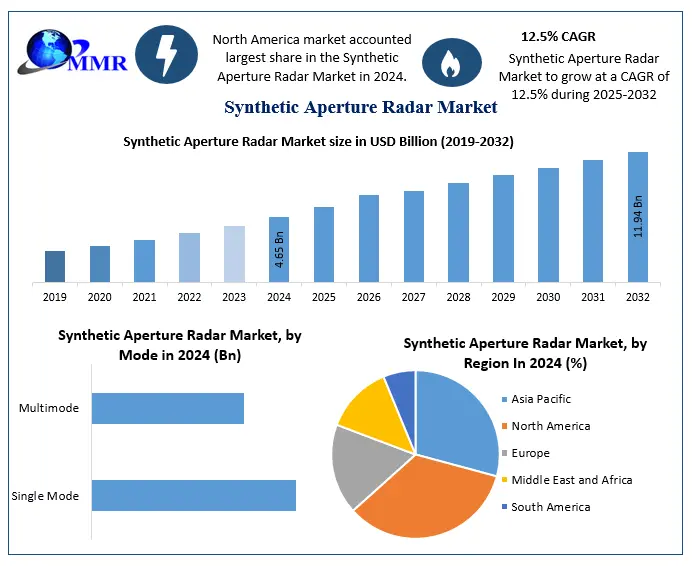
Synthetic Aperture Radar Market
Every radar pulse now feeds AI models hungry for real-time intelligence. SAR has become the non-negotiable backbone of the global digital security economy.
“SAR transitions from imaging to intelligence. X-band resolution leadership meets Asia-Pacific volume scale, this anchors the geospatial security economy through 2032,” says Maximize Market Research. ”
ROCKVILLE , MD, UNITED STATES, April 16, 2026 /EINPresswire.com/ -- Synthetic Aperture Radar Market is evolving from a niche sensor into a USD 11.94 billion strategic intelligence powerhouse by 2032. Valued at USD 4.65 billion in 2024, its 12.5% CAGR is fueled by a critical advantage: total all-weather reliability. While optical sensors fail in darkness or cloud cover, SAR provides persistent, uninterrupted insight. — Maximize Market Research
Get Full PDF Sample Copy of Report: (Including Full TOC, List of Tables & Figures, Chart) @ https://www.maximizemarketresearch.com/request-sample/15470/
The industry is undergoing a structural pivot. By integrating AI and Machine Learning, raw data is now converted into automated, real-time intelligence. As defense and commercial sectors prioritize actionable geospatial assets over mere imagery, SAR has become the non-negotiable backbone of global security and environmental compliance monitoring.
Global Security’s Invisible Sentinels: The Shift to Non-Discretionary SAR
Three forces are propelling the SAR Market beyond traditional cycles. NATO and Indo-Pacific defense modernization now mandate all-weather, space-based radar for persistent surveillance. Simultaneously, microsatellite SAR constellations are slashing costs, while escalating climate risks make L-band and C-band analysis essential for cloud-penetrating agricultural and disaster monitoring.
Real-Time Signal: In early 2026, the EU’s "Radar-First" directive prioritized SAR data for all member-state climate compliance, making radar imaging a regulatory requirement rather than an option.
The Friction Points: Why Speed to Scale is a Challenge
Despite demand, high deployment costs and processing complexity remain barriers. Supply chain volatility for GaN components, vital for digital beamforming strains mid-tier procurement. Additionally, the GPU-heavy AI pipelines required to process raw imagery at speed create a two-tier market, favoring well-capitalized incumbents and venture-backed constellation operators who can scale at the pace of modern global demand.
The $7.29 Billion Frontier: AI, Precision, and Mandated Growth
The market’s highest-value pivot is the integration of AI/ML with miniaturized platforms. While X-band leads in sub-25cm defense demand, government mandates for disaster management are creating a non-cyclical revenue floor. Following record-breaking global floods in 2025, over 40 nations now legislate SAR access into emergency budgets.
Real-Time Signal: Palantir’s 2026 AIP update now processes SAR change-detection in under 5 minutes, proving that the value has shifted from the "image" to the "instant decision."
Follow the Signal: Where SAR Investment Peaks
High-growth capital is shifting toward X-band for tactical precision and C-band for maritime monitoring. While satellite constellations dominate, airborne SAR is surging to bridge critical revisit gaps. The fastest-growing vertical? Disaster Management, now a non-discretionary government priority requiring real-time geospatial intelligence for emergency infrastructure through 2032.
By Frequency Band
X-band
Ka-band / mmW
L-band
C-band
Others
By Platform
Space-based
Airborne SAR
Ground-based SAR
By Application
Defense & Security
Environmental Monitoring
Disaster Management
Agriculture
Others
By Mode
Stripmap
Spotlight
ScanSAR
Interferometric SAR (InSAR)
By Region
North America
Asia-Pacific
Europe
South America
Middle East and Africa
Get Full PDF Sample Copy of Report: (Including Full TOC, List of Tables & Figures, Chart) @ https://www.maximizemarketresearch.com/request-sample/15470/
Strategic Geo-Orbits: The Global Battle for SAR Supremacy
North America: The Innovation Titan North America maintains its market stronghold through a powerful alliance of defense giants like Lockheed Martin and agile disruptors like Capella Space. The region’s decisive edge lies in AI-integrated analytics, converting raw radar into sub-8-minute tactical alerts.
Capella Space’s 2025 launch achieved daily global revisits at sub-50cm resolution, proving that commercial constellations can now match classified national capabilities.
Asia-Pacific: The Volume Powerhouse APAC is the world’s fastest-growing corridor, fueled by aggressive national constellation programs in China, India, and
Japan. Driven by maritime security and disaster monitoring, the region is transitioning from a consumer to a global commercial exporter of SAR technology.
The 2025 NASA-ISRO NISAR mission, the highest-cadence global scan in history now monitors Earth's surface every 12 days, establishing a massive data floor for environmental and agricultural oversight across the Indo-Pacific.
Europe: The Regulatory Guardian Anchored by Airbus and the ESA Copernicus program, Europe leads in C-band infrastructure. Here, SAR is no longer optional; EU environmental mandates have turned satellite monitoring into a regulatory necessity for climate compliance and deforestation tracking through 2032.
FOUR TECHNOLOGICAL INFLECTIONS PERMANENTLY REWRITING THE SYNTHETIC APERTURE RADAR FORECAST THROUGH 2032
AI-Driven Real-Time IntelligenceAI/ML integration converts raw SAR data into actionable decisions in minutes. Platforms like Palantir now deliver automated alerts within 8 minutes, transforming sensors into critical decision-support systems.
Breakthrough Tactical ResolutionSub-25cm imaging resolutioneliminates the gap between SAR and optical sensors. Combined with digital beamforming, this delivers classified-level tactical precision at commercially accessible price points.
Economic Democratization via MicrosatellitesMiniaturized payloads have slashed constellation costs from $500M to under $15M per satellite. This enables global competition on revisit frequency, accelerating SAR use in insurance and commodities.
Regulation-Backed Demand FloorOver 34 nations now mandate SAR data for disaster response. This shift from discretionary to recurring operational expenditure creates a stable, non-cyclical revenue base through 2032.
The Orbital Power Map: The Global Battle for SAR Dominance
Synthetic Aperture Radar Market is transitioning from legacy consolidation to high-velocity disruption. While defense primes maintain heritage dominance, commercial challengers like ICEYE and Capella Space are slashing costs and latency. The decisive competitive lever through 2032 is AI-enabled analytics integration; operators delivering real-time intelligence products over raw imagery will capture the highest market margins.
Synthetic Aperture Radar Market Key Players
Airbus Defence and Space
Lockheed Martin Corporation
Northrop Grumman Corporation
Thales Group
Raytheon Technologies
Leonardo S.p.A.
Israel Aerospace Industries (IAI)
ICEYE
Capella Space
Umbra
MDA Ltd.
Maxar Technologies
GHGSat
SAR-Image (JAXA)
Satellogic
Get access to the full description of the report @ https://www.maximizemarketresearch.com/market-report/global-synthetic-aperture-radar-market/15470/
Key Recent Developments in the Global Synthetic Aperture Radar Market
January 2025 - Capella Space successfully launched its 6th X-band SAR microsatellite, achieving a breakthrough daily global revisit capability at sub-50cm resolution. This development validates the commercial viability of high-cadence, tactical-resolution SAR, significantly expanding enterprise-level procurement for critical maritime tracking and large-scale infrastructure monitoring.
Q3 2025 - ICEYE secured USD 100 million in Series D funding to scale its X-band video SAR constellation to over 20 satellites. This positions ICEYE as the pioneering commercial operator for persistent video SAR, a move that fundamentally redefines the economics of maritime surveillance by allowing for real-time motion tracking from space.
2025 - Umbra reached a milestone by achieving sub-25cm commercial SAR resolution, becoming the first private operator to match classified national-program specifications at open-market price points. By eliminating the resolution gap between radar and traditional optical imagery, Umbra is accelerating the shift toward commercial data procurement by global defense contractors.
2025 - NASA-ISRO (NISAR) , The NISAR satellite was launched, featuring dual L-band and S-band SAR capabilities to scan the entire Earth's surface every 12 days. As the highest-cadence global SAR mission in history, it establishes a vital data infrastructure for environmental monitoring, driving massive government procurement for agricultural oversight, disaster response, and climate risk analytics.
March 2025 - Northrop Grumman was awarded a USD 280 million contract by the U.S. Air Force for next-generation airborne SAR reconnaissance systems featuring integrated AI processing. This contract confirms the sustained institutional demand for AI-enhanced airborne platforms, reinforcing North America’s dominance in the high-end defense sector through 2032.
FAQs: Global Synthetic Aperture Radar Market
Q1. What is the current Synthetic Aperture Radar Market size and forecast to 2032?
Ans. Valued at $4.65B in 2024, the market hits $11.94B by 2032 (12.5% CAGR), driven by AI integration, defense modernization, and microsatellite expansion.
Q2. What are the primary growth drivers in the Global SAR Industry Analysis?
Ans. Key drivers include AI-driven data processing, affordable microsatellite constellations, persistent military surveillance demand, and government-mandated disaster management procurement across 34+ nations.
Q3. Which frequency band leads the Synthetic Aperture Radar Market and why?
Ans. X-band leads due to superior high-resolution military imaging. C-band remains vital for environmental monitoring, maritime tracking, and commercial agricultural assessment applications.
Q4. Which region leads SAR Market growth and which is fastest-growing?
Ans. North America holds the largest revenue share. Asia-Pacific is the fastest-growing, fueled by Chinese, Indian, and Japanese national space programs and maritime requirements.
Q5. How does AI integration impact the Synthetic Aperture Radar Forecast 2032?
Ans. AI converts raw sensors into real-time decision systems, enabling automated object classification and expanding SAR’s utility into insurance, commodities, and climate risk analytics.
Analyst Perspective
The Synthetic Aperture Radar Market’s 12.5% CAGR to $11.94 billion by 2032 reflects a structural shift toward AI-driven geospatial intelligence. Driven by defense, climate monitoring, and commercial data, growth is centered on North American innovation and Asia-Pacific volume. Future dominance belongs to operators who leverage digital beamforming and autonomous pipelines to deliver real-time, actionable intelligence products rather than traditional imagery files, fundamentally redefining the SAR Market Size and value.
Related Reports
Aerospace and Defense Market: https://www.maximizemarketresearch.com/market-report/global-aerospace-and-defense-market/4726/
Aerospace and Defense Market by Platform (Fixed Wing, Rotorcraft, Space), Application (Commercial, Military), and Region-Global Forecast to 2032
Satellite Communication Market: https://www.maximizemarketresearch.com/market-report/global-satellite-communication-market/6004/
Satellite Communication Market by Band (C, Ku, Ka), Application, End-Use (Government, Commercial), and Region-Global Forecast to 2032
Earth Observation Satellite Market: https://www.maximizemarketresearch.com/market-report/earth-observation-satellite-market/214699/
Earth Observation Satellite Market by Orbit (LEO, MEO, GEO), Application (Defense, Agriculture, Environmental), and Region-Global Forecast to 2032
Military Satellite Market: https://www.maximizemarketresearch.com/market-report/military-satellite-market/135963/
Military Satellite Market by Type (Communication, Navigation, Reconnaissance), Application, and Region-Global Forecast to 2032
Radar System Market: https://www.maximizemarketresearch.com/market-report/radar-system-market/86843/
Radar System Market by Type (Primary, Secondary), Platform (Land, Naval, Airborne, Space), Application, and Region-Global Forecast to 2032
Top Reports:
Medical Enzyme Technology Market
Liquid Sugar Market
About Maximize Market Research Pvt. Ltd.
Maximize Market Research is a premier global consulting firm headquartered in Pune, India. Serving clients across 45+ countries, MMR delivers high-granularity market intelligence across Aerospace & Defense, Electronics, Energy & Power, and Advanced Technology, empowering enterprises with data-driven insights to make strategic decisions with confidence.
Domain Focus
This report falls under Maximize Market Research’s Aerospace & Defense domain, spanning synthetic aperture radar technology, earth observation satellites, military surveillance radar, space-based radar systems, and commercial SAR applications across 45+ countries — delivering the intelligence defense contractors, satellite operators, and geospatial investors need to navigate the evolving global SAR market with precision through 2032.
Lumawant Godage
MAXIMIZE MARKET RESEARCH PVT. LTD.
+91 96073 65656
akash.r@maximizemarketresearch.com
Visit us on social media:
LinkedIn
Instagram
Facebook
X
Legal Disclaimer:
EIN Presswire provides this news content "as is" without warranty of any kind. We do not accept any responsibility or liability for the accuracy, content, images, videos, licenses, completeness, legality, or reliability of the information contained in this article. If you have any complaints or copyright issues related to this article, kindly contact the author above.
